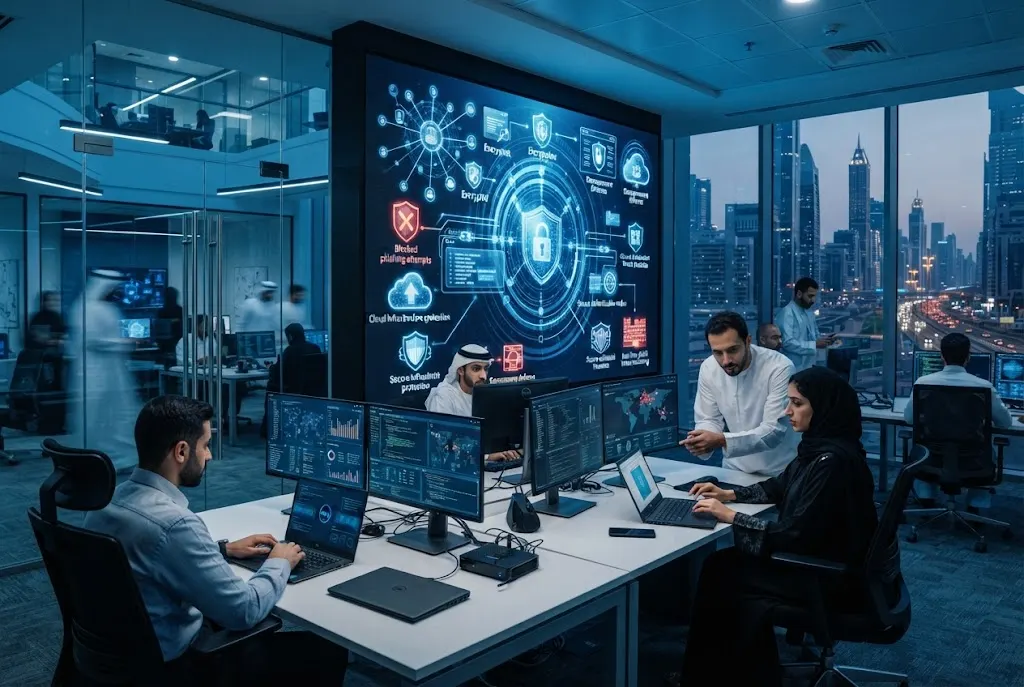
Modern attacks can target email accounts, smartphones, websites, cloud platforms, payment systems, employee credentials, and connected devices. Some attacks rely on sophisticated technical vulnerabilities, while others depend primarily on social engineering and human error. A strong security strategy therefore requires both appropriate technology and informed users.
Why Cybersecurity Matters in the UAE
The UAE has a highly connected digital economy. Organizations increasingly use cloud applications, online banking, digital payments, e-commerce platforms, remote collaboration tools, and automated business systems.
This digital environment creates significant opportunities for businesses, but it also increases the number of systems and accounts that need protection. A company may have employees accessing cloud applications from multiple locations, customers interacting with an online store, and administrators managing websites and business software remotely.
Organizations can strengthen this environment by combining security practices with tools such as cybersecurity tools for small businesses, password managers, endpoint protection, secure networks, and multi-factor authentication.
1. Phishing Attacks
Phishing is one of the most common forms of cyberattack. Attackers send messages designed to appear legitimate and attempt to persuade recipients to reveal passwords, payment information, authentication codes, or other sensitive data.
Phishing messages can arrive through email, messaging applications, social media, websites, and other communication channels. They may impersonate banks, government services, delivery companies, technology providers, employers, or business partners.
Some phishing campaigns use convincing branding, urgent language, fake login pages, or personalized information. Employees and consumers should therefore examine unexpected requests carefully instead of relying only on visual appearance.
How to Reduce Phishing Risk
Businesses should provide regular security awareness training, enable multi-factor authentication, use email security controls, and establish clear procedures for reporting suspicious messages.
Users should also avoid entering credentials through links in unexpected messages. When an important account requires attention, opening the official website or application directly can provide a safer way to access the service.
2. Ransomware
Ransomware is malicious software designed to restrict access to systems or data, commonly by encrypting files. Attackers may then demand payment in exchange for attempting to restore access.
A ransomware incident can disrupt operations, prevent employees from accessing important documents, and create significant recovery costs. Businesses that depend heavily on digital records can be particularly affected.
Reliable backups are therefore an important component of ransomware resilience. Organizations should maintain appropriate backups, protect them from unauthorized access, and regularly test whether critical information can actually be restored.
Cloud infrastructure can also play an important role in business continuity. Companies evaluating cloud environments can compare AWS and Azure while considering security, backup, identity, and recovery requirements.
3. Credential Theft
Stolen usernames and passwords can provide attackers with access to email accounts, cloud applications, websites, financial systems, and business platforms.
Credential theft can happen through phishing, malicious software, fake login pages, password reuse, data breaches, or social engineering.
Organizations should encourage employees to use unique passwords and protect them with a reputable password manager. The guide to password managers for UAE users provides additional context on protecting account credentials.
Multi-factor authentication should also be enabled for important accounts whenever the service supports it. MFA can provide an additional security layer when a password has been exposed.
4. Business Email Compromise
Business email compromise involves attackers attempting to manipulate employees or organizations through compromised or impersonated email accounts. The objective may include fraudulent payments, unauthorized access, sensitive information theft, or changes to account details.
These attacks can be particularly dangerous because they may resemble normal business communication. An employee could receive a message appearing to come from an executive, supplier, customer, or financial contact.
Businesses should establish verification procedures for financial transactions and sensitive account changes. Requests involving unusual payments, urgent transfers, or changes to bank details should receive independent confirmation through a trusted communication channel.
5. Malware
Malware is a broad category covering malicious software designed to compromise devices, steal information, damage systems, or provide unauthorized access.
Also, Malware can arrive through malicious attachments, compromised websites, unsafe downloads, infected applications, removable devices, or deceptive links.
Modern endpoint security products can help detect suspicious files and behavior. However, businesses should also keep operating systems and applications updated and limit the installation of unauthorized software.
6. Data Breaches
A data breach can expose sensitive information such as customer records, employee information, business documents, account credentials, or other confidential data.
Breaches can result from compromised credentials, vulnerable applications, misconfigured cloud resources, malicious insiders, stolen devices, or software vulnerabilities.
Businesses should identify what information they hold, where it is stored, who can access it, and how long it needs to be retained. Access permissions should follow the principle of giving users only the access required for their responsibilities.
Companies working extensively with business information should also consider the security implications of data analytics environments and other systems that collect, process, and share organizational data.
7. Social Engineering
Social engineering attacks manipulate people rather than relying exclusively on technical vulnerabilities. Attackers may pretend to be colleagues, customers, vendors, support agents, or other trusted contacts.
The attacker may attempt to create urgency or authority to convince a target to reveal information or perform an action. For example, an employee could be asked to disclose a verification code or approve an unexpected payment.
Security awareness is one of the most important defenses against these attacks. Employees should understand that legitimate-looking communication does not automatically mean a request is genuine.
8. Website and Web Application Attacks
Businesses operating websites and web applications can face attacks targeting vulnerabilities in software, plugins, authentication systems, APIs, or server configurations.
Organizations should keep software updated, remove unused components, protect administrative accounts, use secure authentication, monitor suspicious activity, and maintain reliable backups.
E-commerce businesses should be particularly careful because their websites may process customer accounts, orders, payments, and integrations with third-party services. Companies considering online stores can also review e-commerce platforms for UAE businesses with security and administration requirements in mind.
9. DDoS Attacks
Distributed denial-of-service attacks attempt to overwhelm a website, server, or online service with large amounts of traffic or requests. When successful, the targeted service may become slow or unavailable.
For businesses that depend on online services, downtime can affect customers, employees, transactions, and business operations.
Organizations operating important public-facing services should consider appropriate network protection, traffic monitoring, hosting architecture, and DDoS mitigation services.
10. Attacks on Cloud Accounts
Cloud services can provide flexibility and scalability, but compromised cloud accounts can expose significant amounts of business information.
An attacker who gains administrative access to a cloud environment may be able to access data, modify configurations, create resources, or interfere with business systems.
Cloud security should therefore include strong identity controls, MFA, appropriate permissions, activity monitoring, secure configurations, and regular access reviews.
Businesses can also review cloud storage platforms when evaluating how business documents and other data should be stored and protected.
11. Mobile and Device Security Risks
Smartphones and tablets are now used for email, authentication, banking, communication, business applications, and remote work. A compromised mobile device can therefore become a gateway to valuable accounts and information.
Businesses should use screen locks, device encryption where available, application updates, secure authentication, and appropriate mobile-management policies.
Employees should also avoid installing applications from untrusted sources and should be cautious when connecting to unfamiliar networks.
12. Unsecured Public Wi-Fi
Public Wi-Fi can create additional security risks when users connect to networks they cannot verify or control. Attackers may attempt to intercept traffic, redirect users to malicious websites, or create deceptive networks that resemble legitimate hotspots.
Employees working remotely should use trusted networks whenever possible and follow company policies for secure remote access. A properly configured VPN can provide another layer of protection, although it should not replace other security controls.
Businesses can review VPN services in the UAE as part of a broader remote-work security strategy.
13. Insider Threats
Not every security incident originates outside an organization. Employees, contractors, and other authorized users may accidentally or deliberately expose sensitive information.
Accidental incidents can involve sending confidential files to the wrong recipient, using insecure storage, misconfiguring permissions, or losing a device.
Organizations can reduce these risks through access controls, employee training, activity monitoring, clear policies, and appropriate offboarding procedures.
14. Software Vulnerabilities
Outdated software can contain vulnerabilities that attackers may exploit. This can include operating systems, browsers, plugins, business applications, servers, networking equipment, and cloud-connected services.
Patch management should therefore be part of a regular business process. Organizations should maintain an inventory of important software and establish procedures for applying security updates in a timely manner.
15. AI-Assisted Cyberattacks
Artificial intelligence is becoming part of the broader cybersecurity landscape. Attackers can use automation and generative AI to produce convincing messages, accelerate research, or support certain stages of an attack.
At the same time, AI can support defensive security operations by helping analyze large volumes of information, identify unusual activity, and prioritize security alerts.
Businesses interested in the wider technology landscape can explore generative AI and the growing range of AI tools being used across modern organizations.
How UAE Businesses Can Strengthen Cybersecurity
Businesses can take several practical steps to improve their security posture. The first is to identify critical systems and information. Organizations should know which accounts, devices, applications, websites, and data are essential to operations.
The next step is to protect those assets with layered security controls. These can include strong authentication, password management, endpoint protection, secure backups, email security, network controls, monitoring, and employee training.
Businesses should also regularly review administrator accounts and remove access that employees no longer require. Former employees and inactive accounts should not retain unnecessary access to business systems.
Security policies should be practical and easy for employees to follow. Staff should know how to report phishing attempts, suspicious login notifications, unexpected payment requests, and potentially compromised devices.
Creating a Cybersecurity Incident Response Plan
Even well-protected organizations should prepare for the possibility of a security incident. A basic incident response plan should identify who is responsible for investigating an incident, securing affected systems, communicating with stakeholders, and restoring normal operations.
Businesses should also document important contacts and recovery procedures before an incident occurs. Waiting until systems are compromised can make the response more difficult.
Regularly testing backups and recovery procedures can reveal problems before an actual emergency. Businesses should verify that critical information can be restored and that responsible employees understand the process.
The Role of Cybersecurity Tools in UAE Businesses
Cybersecurity tools are most effective when they form part of a broader security program. A password manager cannot prevent every phishing attack, while antivirus software cannot compensate for weak access controls or untested backups.
Small businesses can start with foundational protections and expand their security stack as their operations become more complex. Larger organizations may require additional monitoring, vulnerability management, identity controls, security operations, and specialized incident-response capabilities.
Automation can also help organizations manage repetitive security processes. Businesses exploring this area can learn more about AI automation trends in the UAE and broader workflow automation for businesses.
Final Thoughts
The common cybersecurity threats in UAE include phishing, ransomware, credential theft, business email compromise, malware, data breaches, social engineering, website attacks, DDoS attacks, cloud account compromise, insider risks, and software vulnerabilities.
There is no single security product that can eliminate every risk. Effective cybersecurity requires multiple layers working together, supported by regular updates, secure authentication, employee awareness, access management, monitoring, and tested recovery procedures.
As UAE businesses continue adopting cloud services, digital payments, e-commerce, artificial intelligence, automation, and other connected technologies, cybersecurity should remain part of technology planning from the beginning rather than being treated as an afterthought.
For more UAE-focused technology guidance, cybersecurity resources, business technology comparisons, and digital trends, visit the UAE TechZone homepage.
For a broader cybersecurity framework, organizations can also consult the NIST Cybersecurity Framework for structured guidance on managing cybersecurity risk.